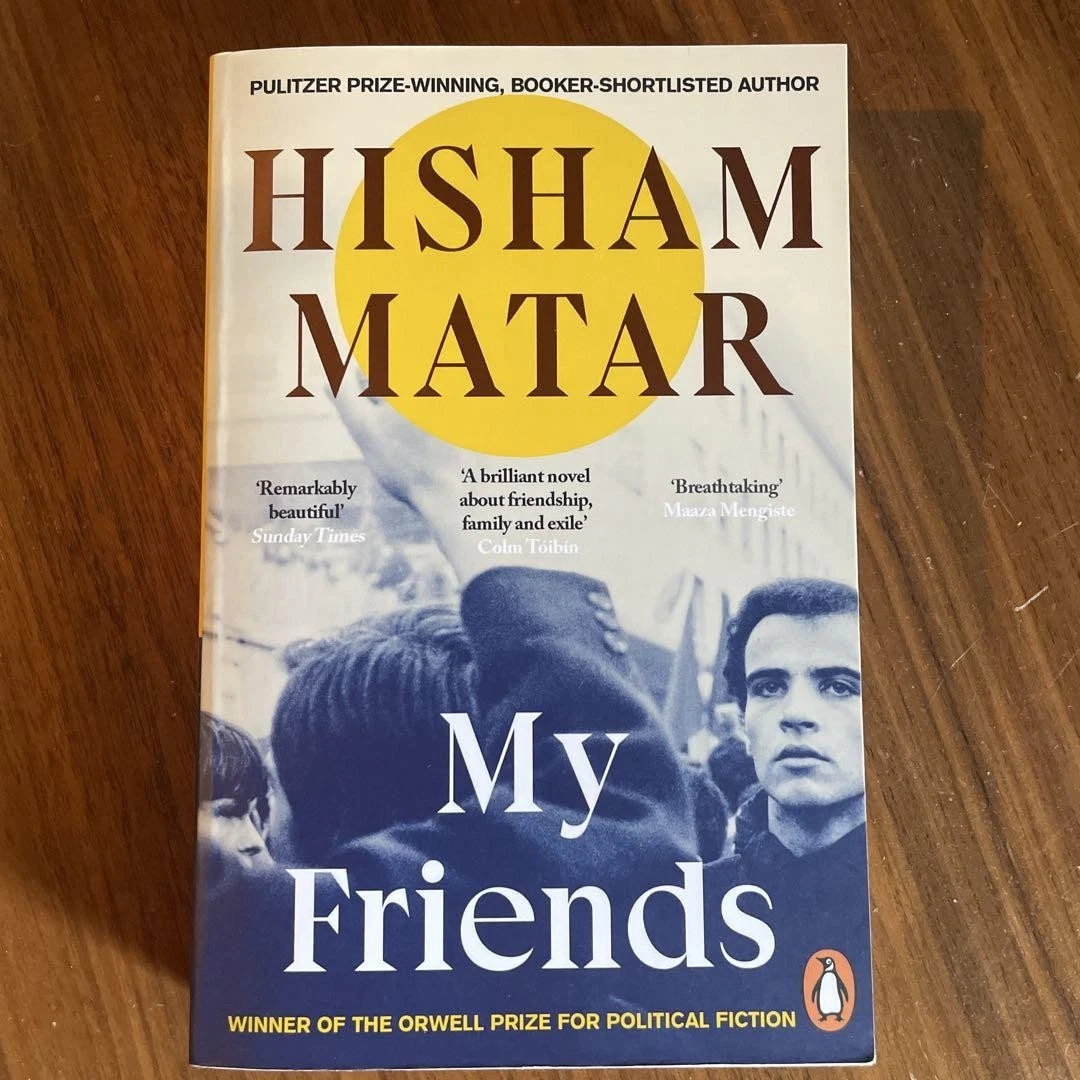
Although I usually prefer reading the words on the page, a season of long drives led me to the audiobook of My Friends, narrated by Hisham Matar himself. I am glad I did. Only the author—with his calm voice and perfect accent—could render the novel’s quiet intimacy and restrained emotion so faithfully. While the principal themes are exile, friendship, and moral responsibility, this novel also underlines the importance of the arts. Told in the first person through Khaled, a young Libyan student in 1980s London, the book transforms a single historical incident into a lifelong meditation on exile and friendship.
The turning point is the 1984 shooting outside the Libyan Embassy, which killed Yvonne Fletcher, a young British policewoman, and wounded several protesters. Khaled, who has agreed on a whim to accompany another student to the demonstration, is caught in the crossfire. Though he survives, his involvement is impossible to hide, and his life veers in a new direction. Exile begins almost by accident—a momentary impulse that becomes destiny.
Listening to Matar’s voice, I was struck by the tenderness of Khaled’s inner dialogue and the candor with which he perceives the world around him. The narration is free of sensationalism; the pacing is unhurried, reflective, and deliberate.
The story’s historical frame also awakened personal memories. I recall watching French television coverage of the same events, France’s efforts to limit Gaddafi’s influence on Africa, and Europe’s attempts to counter Gaddafi’s use of terrorism as a foreign policy tool. Yet interviews with Libyan dissidents were rare; speaking publicly could be fatal. This account, though fictional, feels like a testimony.
What makes the book so compelling is that Khaled is not a revolutionary hero. The protagonist is aware of the privilege he has to study in the UK; he knows that fellow Libyans are watching him and reading his mail. And yet, one spur-of-the-moment decision alters his destiny. For fear of hurting them, Khaled hides his experience from his family. Instead, he bonds with his friends through their shared trauma.
From that point on, we witness the changes in the relationships between Khaled and his few friends. Most of the friends are introduced before the shooting, while the rest are introduced to us after. Each character responds to trauma in a way that reflects their personality. As a result, their relationships don’t just ebb and flow; the friends also become mirrors, reflecting each other in all their beauty and flaws. While Khaled leans on those friendships, they quietly force Khaled to face his moral responsibilities and life choices.
Before the shooting, his circle is defined by camaraderie and debate; afterward, those same friendships become mirrors of moral reckoning. I love how the author captures the subtle shift in accent that signals new class belonging, the mixture of Arabic and English among friends. In this, My Friends recalls Elena Ferrante’s My Brilliant Friend—another study of long friendship across time. Yet Matar’s world is quieter, stripped of drama. Where Ferrante put her protagonists through upheavals, Matar’s focus is more meditative.
The novel is also an exploration of identity and belonging. Through decades in Shepherd’s Bush, London ceases to be a stopgap and becomes home. Khaled evolves from a newcomer to a Londoner whose small apartment becomes an anchor, the tangible proof that he still exists somewhere.
Matar resists the urge to dramatize politics; instead, he writes the long aftermath of protest. The result is a novel of extraordinary stillness, one that brings to life the silences that are essential to this story. Hisham Matar’s novel is also a beautiful exploration of family, identity, and belonging.
For readers of our time—when student movements and immigrant protesters across Europe, and the United States face renewed scrutiny and even the threat of deportation—Khaled’s story feels unsettlingly current. It reminds us that dissent often begins in youth and that the cost of speaking out may follow a person for decades.