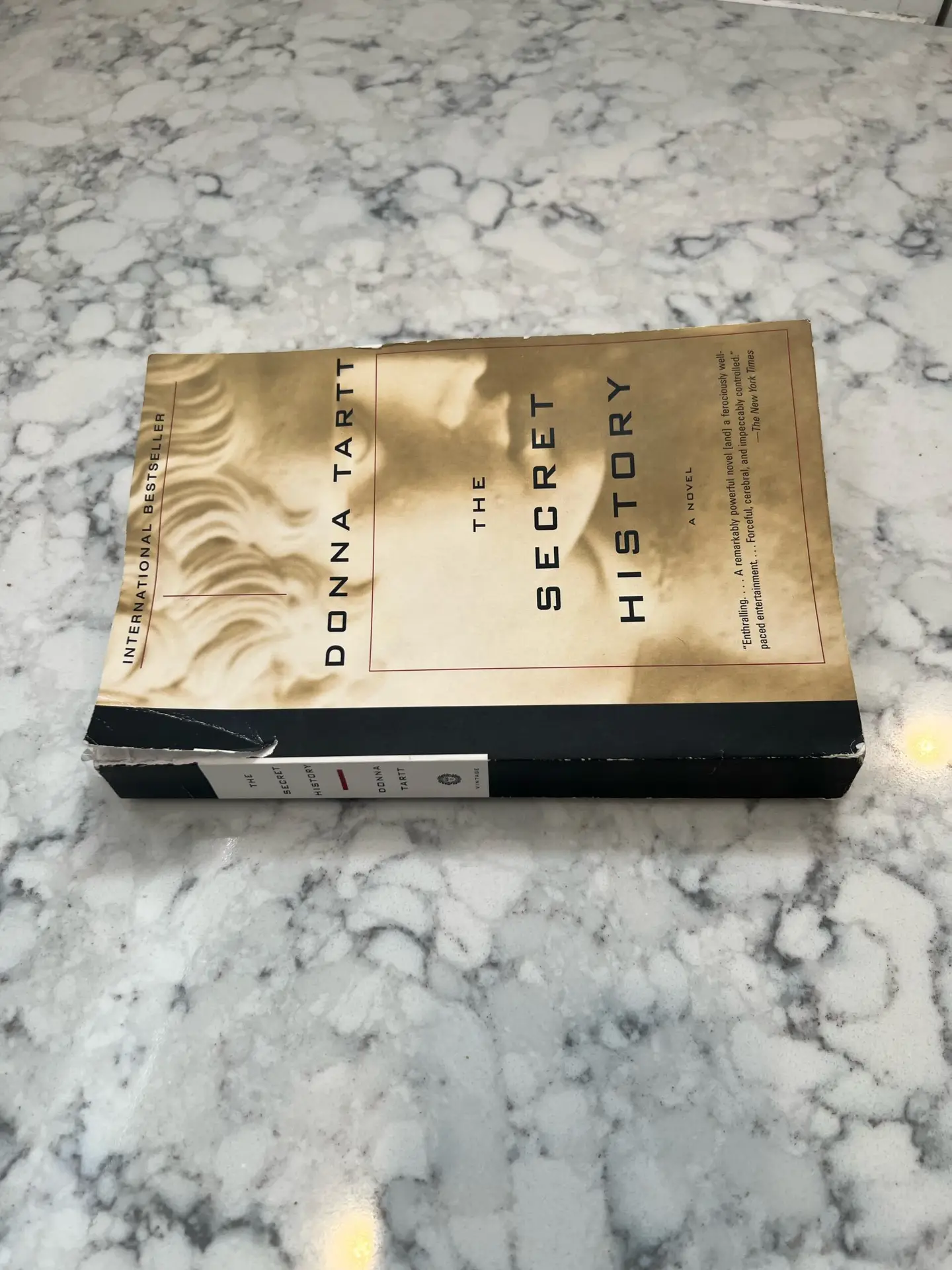
Donna Tartt’s The Secret History is one of those novels that creates a sealed atmosphere and locks you inside it. From the first pages, I felt the chill of Vermont, the hush of libraries, the cultivated eccentricities of an academic world that believes it’s operating by different rules. It’s deeply immersive: you don’t merely observe Hampden College—you live there, sometimes in a daze, the way some of the characters do. And it’s pretty remarkable to realize that Tartt didn’t just write a bestseller; she helped spark an entire aesthetic—what we now call dark academia—with its intoxicating mix of classics, elitism, beauty, dread, and moral decay.
A quick aside: my daughter lent me her copy in pristine condition, and I somehow destroyed it through a string of unfortunate accidents—the highlight being the book sliding off a shelf into the sink, where a motion-sensor tap immediately turned on. She has since put me on probation, and I have no idea when she’ll trust me with another book.
Part of the pleasure for me was linguistic. I studied Ancient Greek and Latin in middle school, as was common in France then, so I loved the texture of the language exchanges and the classical references that feel less like decoration and more like the private currency of a closed circle. In this book, language isn’t just communication – it’s membership. It’s the velvet rope: the way the characters signal superiority, intimacy, and exclusion all at once. Tartt understands the seduction of languages that promise access to beauty, to belonging, to a lineage of ideas that makes ordinary life feel coarse by comparison.
That seduction seeps into the characters themselves, who sometimes reminded me of students I met in the nineties. I loved them—not because they’re admirable, but because they’re exquisitely, disturbingly alive. Tartt develops their psychology with patience and precision. She shows obsession accruing in layers; charm curdling into control; intellect doubling as refuge and weapon. The group dynamic is especially sharp: the unspoken hierarchies, the shifting loyalties, the way admiration and fear can coexist in the same glance.
Then there’s the protagonist, Richard Papen—flawed in a way that feels essential rather than fashionable. Because the story is told in the first person, we’re stuck inside his gaze: controlled, observant, hungry, and sometimes evasive. And it’s genuinely impressive how convincingly Tartt inhabits that voice. As a female writer, she captures a particular kind of male voice without caricature and without slipping into something “performed.” Richard feels fully lived-in, not “written.” He can describe a room with absolute clarity while remaining vague about his own complicity—until the story corners him. It’s a coming-of-age arc, but not the comforting kind: more a slow education in self-deception, consequence, and the price of wanting the wrong things.
The book’s claustrophobia is part of what makes it so gripping. As secrets harden into a kind of shared prison, the story starts to feel like Jean-Paul Sartre’s Huis Clos (No Exit): a closed room where nobody can leave, where the real punishment isn’t flames but proximity—being watched, judged, and slowly undone by the people who know exactly where to press. There’s also something of Danny Boyle’s Shallow Grave in the way a single catastrophic choice infects everything that follows: paranoia blooms, loyalties rot, and the effort to keep up appearances becomes its own form of violence. The “cover-up” energy—the sense of ordinary days poisoned by what’s hidden—gives Tartt’s campus a thriller pulse beneath the tweed and Latin.
That’s where the themes hit hardest. The Secret History is fundamentally about ethics and accountability, but it doesn’t deliver those ideas like a lecture. It lets them seep in the way moral compromise often does—through rationalizations, through group momentum, through the intoxicating belief that the rules don’t apply to you. This is a coming-of-age story in the most unsettling sense: not about becoming confident or “finding yourself,” but about losing illusions and learning, too late, that intelligence doesn’t protect you from moral failure.
Tartt famously tells you early what will happen, and yet the tension never collapses. It becomes a mystery: the question isn’t what they did so much as how they came to do it—and what it does to them afterward. The slow grind of the aftermath becomes its own thriller. You keep reading to watch pressure rise inside a fragile system and see exactly where it will crack.
And the elegant writing style is a huge part of the pleasure. Tartt can write beauty that intoxicates, then let it sour. There’s a classical restraint to her style that suits a novel obsessed with form, perfection, and the fantasy of aesthetic superiority. Even when the characters behave terribly, the writing holds steady, and that steadiness makes the darkness land harder.
If I have one complaint, it’s a moment of linguistic carelessness that pulled me out of the spell: Tartt confuses Arabic with Farsi. It’s a small detail in the scale of the novel, but it’s jarring considering the students are serious linguists. I’m not the only one who noticed it, which makes me wonder why it wasn’t corrected in later editions.
Still, that doesn’t diminish what The Secret History accomplishes. It remains one of the most compelling portraits of intellectual longing and moral unraveling I’ve read: a story that understands how beauty can be used to justify almost anything, and how the desire to belong can act like anesthesia on your conscience. It lingers—in its atmosphere, its psychology, its characters—and in the slightly uncomfortable recognition that the line between aesthetic devotion and ethical collapse can be thinner than we’d like to believe.
And now I’m curious: do you keep your books pristine as you read them, or do you tear them apart too? My daughter would like to know.