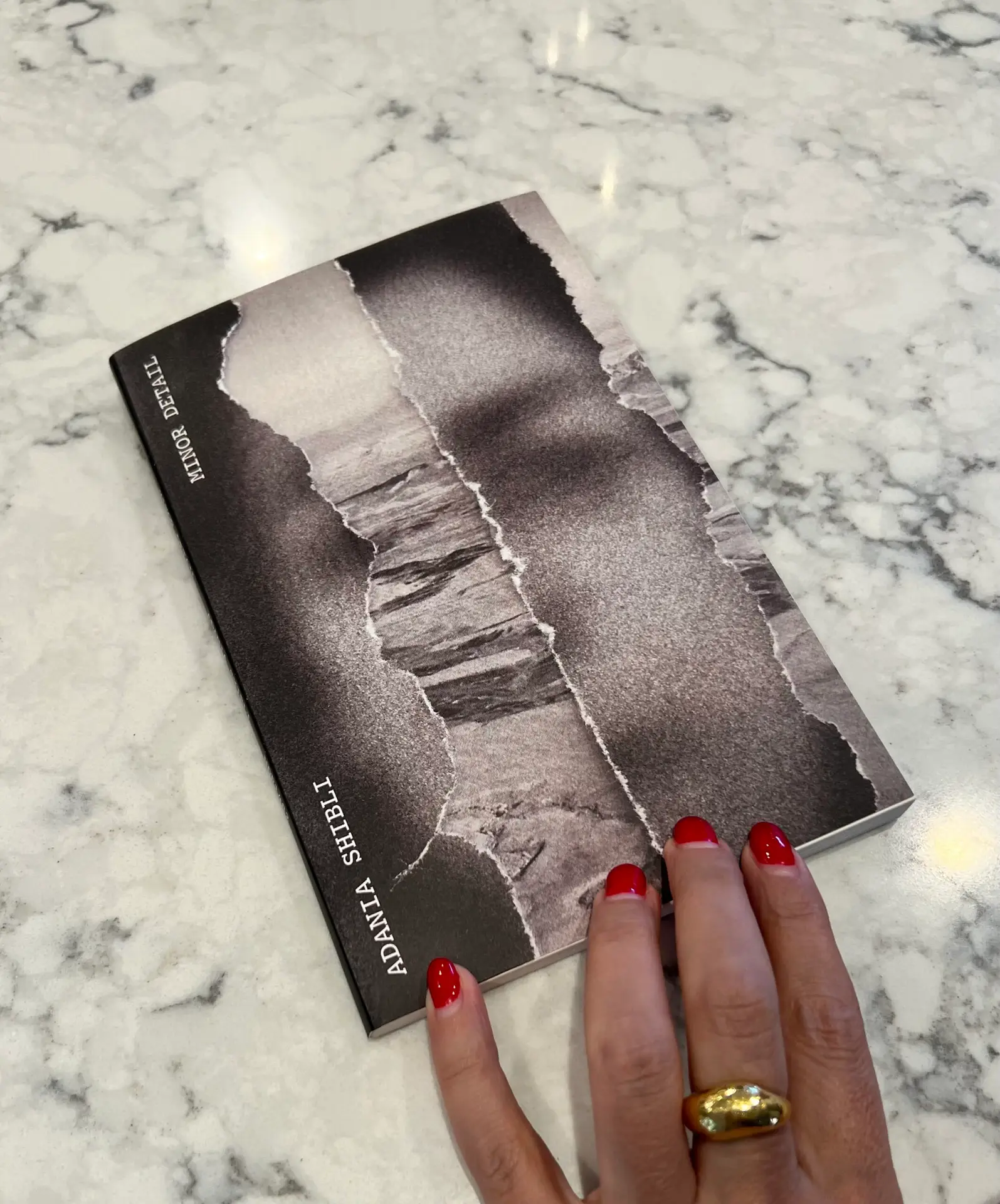
Adania Shibli’s Minor Detail is a short novel that behaves like a pressure chamber. It is emotionally heavy, deeply unsettling, and engineered to sustain a haunting tension long after the final page. Its brevity does not make it accessible; it makes it sharp. Every sentence feels calibrated, as if the book has been pared down to its most charged surfaces. The result can be disorienting: reading sometimes feels blurry or unfocused, not because the prose is unclear, but because Shibli seems to design an atmosphere in which clarity is repeatedly withheld. That experience is intensified by the novel’s political immediacy. This is not violence safely sealed in the past; it reverberates against a present that makes the act of reading feel less like interpretation and more like exposure.
The novel’s most distinctive formal choice is its clinical distance. Shibli narrates traumatic scenes with a controlled, pared-back tone that refuses dramatic emphasis. The effect can resemble dissociation: the language shields itself, and by doing so forces the reader to absorb what is happening without the usual interpretive buffers. In the first part, routine takes on a chilling prominence—shaving, cleaning, inspecting, repeating—mundane acts rendered with almost obsessive specificity. This repetition is not filler. It is a technique that sharpens the horror by placing brutality inside ordinary procedure. The everyday rhythms of soldiers are described with such precision that “normality” becomes one of the book’s most disturbing elements. Violence is not presented as an eruption; it is presented as a function.
This connects to Shibli’s broader method: subtraction. The narrators offer minimal interiority and almost no psychological explanation. There is little of the reflective narration that would normally guide a reader toward meaning, catharsis, or even moral vocabulary. The second part, in particular, is defined by urgency and present-tense survival. The narrator’s thoughts stay close to the immediate world—routes, obstacles, documents, the next decision—suggesting that introspection is not a natural state but a privilege dependent on safety. Under threat, consciousness becomes narrowed and tactical. Shibli’s restraint, then, is not simply an aesthetic posture; it mirrors the conditions of life in a militarized landscape, where thinking too far beyond the next checkpoint can be dangerous.
Thematically, Minor Detail portrays violence as systematic: not exceptional cruelty but an apparatus. Brutality is braided into bureaucracy—zones, permits, labels, maps, boundaries—so that domination is felt both as physical threat and as administrative reality. The book’s sense of dystopia comes less from spectacle than from management: land divided into sterile categories, villages erased, and signage that legislates disappearance. Against this cold logic, the second part introduces a narrator moving through her own homeland like an intruder, as if belonging has been reclassified into trespass. The novel captures how occupation colonizes the everyday, turning driving, parking, walking, and speaking into negotiations with power.
That power also produces moral distortions. Minor Detail suggests the normalization of complicity: the idea that small gestures can be offered as proof of goodness while the structural theft remains intact. Silence becomes participation, daily benefit becomes habit, and habit normalizes the apartheid and occupation. Shibli does not sermonize about this; she lets it sit in the texture of encounters and the hierarchy of speech, where fluent explanations and official archives carry authority while Palestinian presence is repeatedly reduced, fragmented, or made to disappear.
The title offers a key to how the novel works. Shibli builds truth from the incidental—from the specks that are meant to be overlooked. A “minor detail” becomes forensic: the thing that power tries to render trivial is exactly what reveals the system. The second part follows a narrator bent on investigating a decades-old assault, and that pursuit becomes a study in obsession and blindness. The search is driven by death and absence, propelled by the impossibility of closure. Yet the narrator’s focus has a narrowing effect: she strains to recover the story of a murdered girl while struggling to register the living signs around her—warnings, pleas, fragile presences that flicker in and out of view. This is one of the book’s cruellest insights: how trauma can turn attention into a tunnel, and how the desire to know can coexist with the inability to see.
Shibli intensifies this through a pattern of echoing and mirroring across the novel’s two halves. Figures recur—girls, an older woman who appears like a phantom of the life that might have been lived, fleeting visions, the shadow of a girl moving along the same terrain. Things recur too: fuel, spiders, dogs, the heat, routines. These repetitions do not produce symmetry. They expose asymmetry. The same landscape generates radically different realities because power decides what counts as safe, permitted, human.
Much of the novel’s force comes from recurring motifs that are as visceral as they are symbolic. Smell is one of the most potent. A commander is disgusted by the smell of an indigenous girl, yet the stench originates from his own body—from a suppurating wound that refuses to be purified. The motif becomes an indictment of projection: impurity is attributed to the colonized while rot is carried by the colonizer. Washing and cleaning appear as compulsions in both parts, but with different inflections: ritual, obsession, attempted purification, a haunted urge to scrub away what cannot be scrubbed away. Cleanliness becomes both an obsession and a failure.
Animals carry an ominous charge. Dogs, sometimes culturally coded as dirty, become warning systems: their howls feel like prophecy, menace, or moral judgment. Cruelty toward an animal mirrors cruelty toward a human body, and a dog’s circling presence in the second part reads like a deterrent ignored at great cost. Fuel—gasoline or kerosene—appears in both halves as a substance of cleansing and contamination. It can be practical, brutal, and symbolic at once: used on hair, splashed on skin, suggesting both bodily violation and the material bloodstream of empire. Spiders, too, weave through the narrative, provoking fear and obsession in one half and hesitant mercy in the other. Even the smallest creatures seem to press against the occupation’s logic, complicating who is predator and who is prey.
Nature is not mere backdrop; it is politicized. The novel’s specificity—plants, insects, trees—anchors its symbolism in ecology, reminding the reader that land is not an abstract claim but a living system. In the second part, the transformation of landscape—foreign crops, water-intensive cultivation, new buildings—reads as another form of erasure. The myth of “making the desert bloom” is undercut by the sight of what has replaced it: not redemption but re-engineering, a new order imposed on soil and memory alike.
Few scenes capture the book’s ideological coldness better than the museum. The chill inside feels like more than air-conditioning; it feels like temperature as propaganda. The museum becomes a space where history is curated into possession, where archives are controlled narrative, and where the promise of “truth” is exposed as another form of power. The contrast between the narrator’s stutter and the smooth fluency of institutional speech sharpens this point: authority speaks easily; the dispossessed are interrupted even in language.
Translation and naming add another layer. The novel’s clinical style can feel even starker in Arabic precisely because Arabic is often assumed to be lush and adjectival; Shibli’s restraint turns that assumption inside out. Limited modifiers, specialized vocabulary, and deliberate absence create estrangement, as if the language itself has been forced into a new discipline. Naming also reveals point of view: occupier terminology carries political weight, and the choice of place names becomes part of the novel’s moral geometry. Language here is not just communication; it is jurisdiction.
The most unsettling aspect of Minor Detail may be its refusal to offer the reader a stable emotional position. It does not guide, soothe, or explain. It accumulates dread through repetition and detail until the reader is left searching for language adequate to the experience. Even the ending resists satisfaction. Questions of realism arise—particularly in the second part, where the narrator takes risks that can feel reckless—but the book suggests that under occupation, ordinary life is already threaded with danger. The line between recklessness and necessity is often drawn by those who do not have to cross it.
In the end, Minor Detail is devastating not only because of what happens, but because of how it makes what happens inseparable from routine, landscape, language, and time. It makes violence feel infrastructural. It turns the small into evidence and the repetitive into menace. It withholds interiority in a way that becomes its own commentary on survival. And it leaves a reader with the sense that the true horror is not confined to one event or one body, but dispersed through a system so normalized it can present itself as a mere minor detail.